
7 Everyday Activities to Build Your Child's Speech at Home
You don't need fancy toys or an app to help your child talk. These 7 simple, therapist-backed activities turn everyday moments — bath time, snacks, the walk to the shop — into powerful speech practice.
When a child is slow to talk, parents often feel helpless between therapy sessions. You wait for the next appointment, hoping the therapist will fix it. But here is what every good speech therapist will tell you: the real progress happens at home, with you.
Your child spends maybe one hour a week with a therapist — and a hundred hours with you. You don't need special equipment, an app, or perfect English. You need a few simple habits woven into the day you're already living.
Here are seven activities that speech-language pathologists actually recommend — designed for real Indian homes, busy mornings, and ordinary moments.
A note before you start: these activities support your child's communication; they don't replace professional therapy or assessment. If your child has a significant speech delay, please also see a qualified speech-language pathologist (BASLP). Read our guide on early signs of autism in toddlers if you're not sure whether to get assessed.
The one rule that makes all of these work
Before the activities, learn this single habit, because it powers all of them:
Pause. Wait. Let them try.
We adults are too quick. We hand over the biscuit before the child asks. We finish their sentence. We answer our own question. Every time you do this, you accidentally tell the child "you don't need to talk — I already understood."
So slow down. Hold up the snack and wait. Look expectant. Count to five in your head. Give your child the space — and the reason — to communicate. That pause is the most powerful tool you have.
1. Narrate your day out loud
Talk through whatever you're doing, like a friendly commentary. "Mumma is cutting the apple. Cut, cut, cut. Now I wash it. Water! Cold water."
This floods your child with words connected to real things they can see. Keep sentences short and stress the key word. You're not testing them — you're building a word bank they'll draw on later.
Best moments: cooking, folding clothes, bathing your child, walking to the shop.
2. Make them ask — the "sabotage" trick
Gently set things up so your child needs to communicate to get what they want.
Put a favourite toy or snack in a clear box they can't open, and wait.
Give them their bowl without the spoon, and wait.
"Forget" to pour the water, and wait.
The goal isn't to frustrate them — it's to create a real reason to use a word, a sound, a point, or a look. When they communicate in any way, respond instantly and warmly. They learn: communicating works.
3. Sing songs with actions
Songs are a gift for speech. The rhythm, the repetition, and the predictable pattern make words easy to grab onto. Whether it's "Twinkle Twinkle", a Hindi rhyme, or a regional folk song — sing it daily.
The trick: sing a familiar line and then stop right before the last word. "Twinkle twinkle little..." — and wait, looking expectant. Many children who won't say a word on demand will fill in that gap. That's a real word, on their own steam.
4. Offer choices instead of yes/no
Don't ask "Do you want juice?" (the easy answer is just a nod or grab). Instead, hold up two things: "Banana or biscuit?"
Now there's a reason to use a word — even an approximation. Accept any attempt: a sound, the first letter, a point combined with a look. Then say the full word back clearly: "Biscuit! You want biscuit." You're modelling, not correcting.
5. Read together — but don't just read
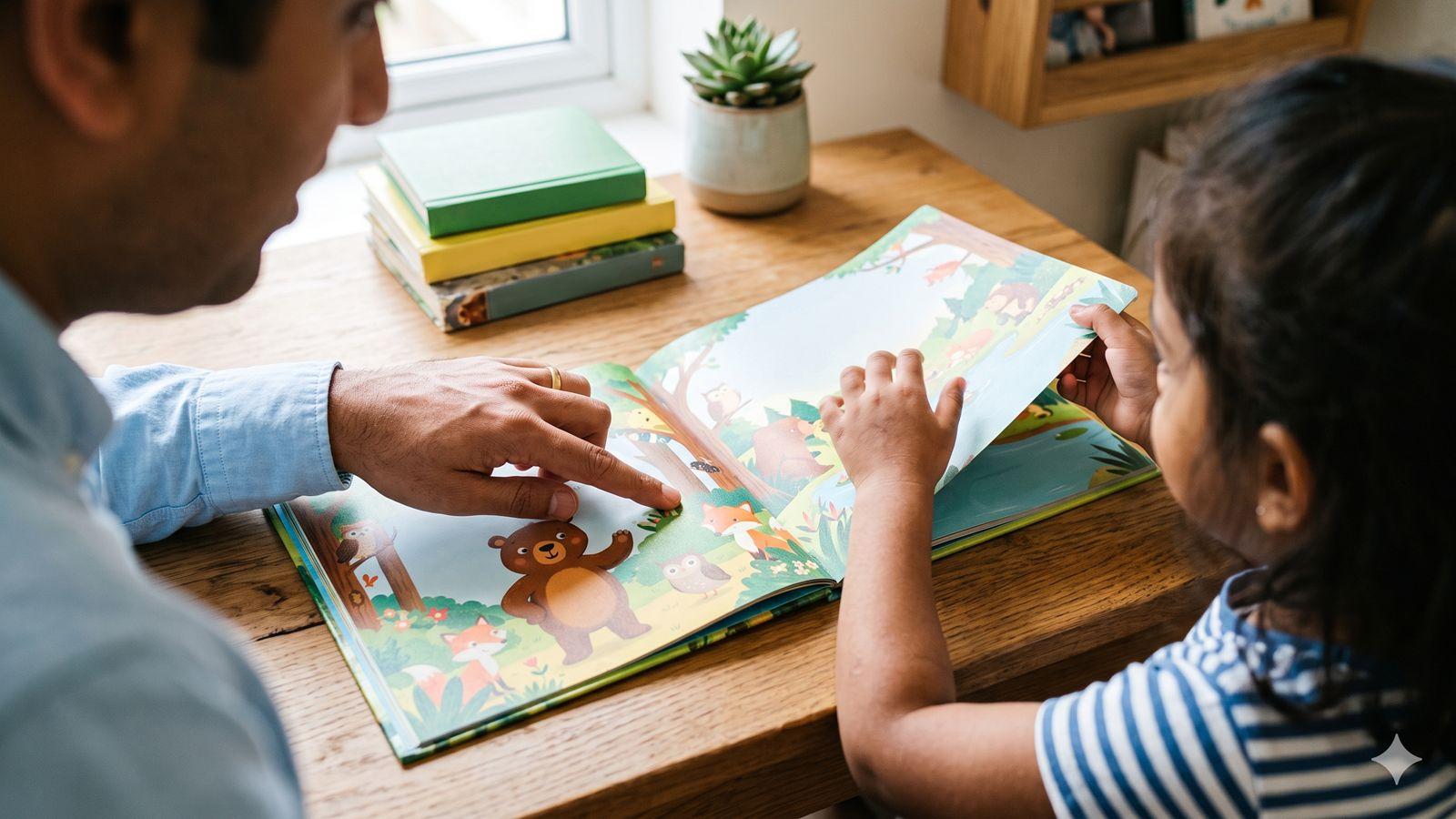
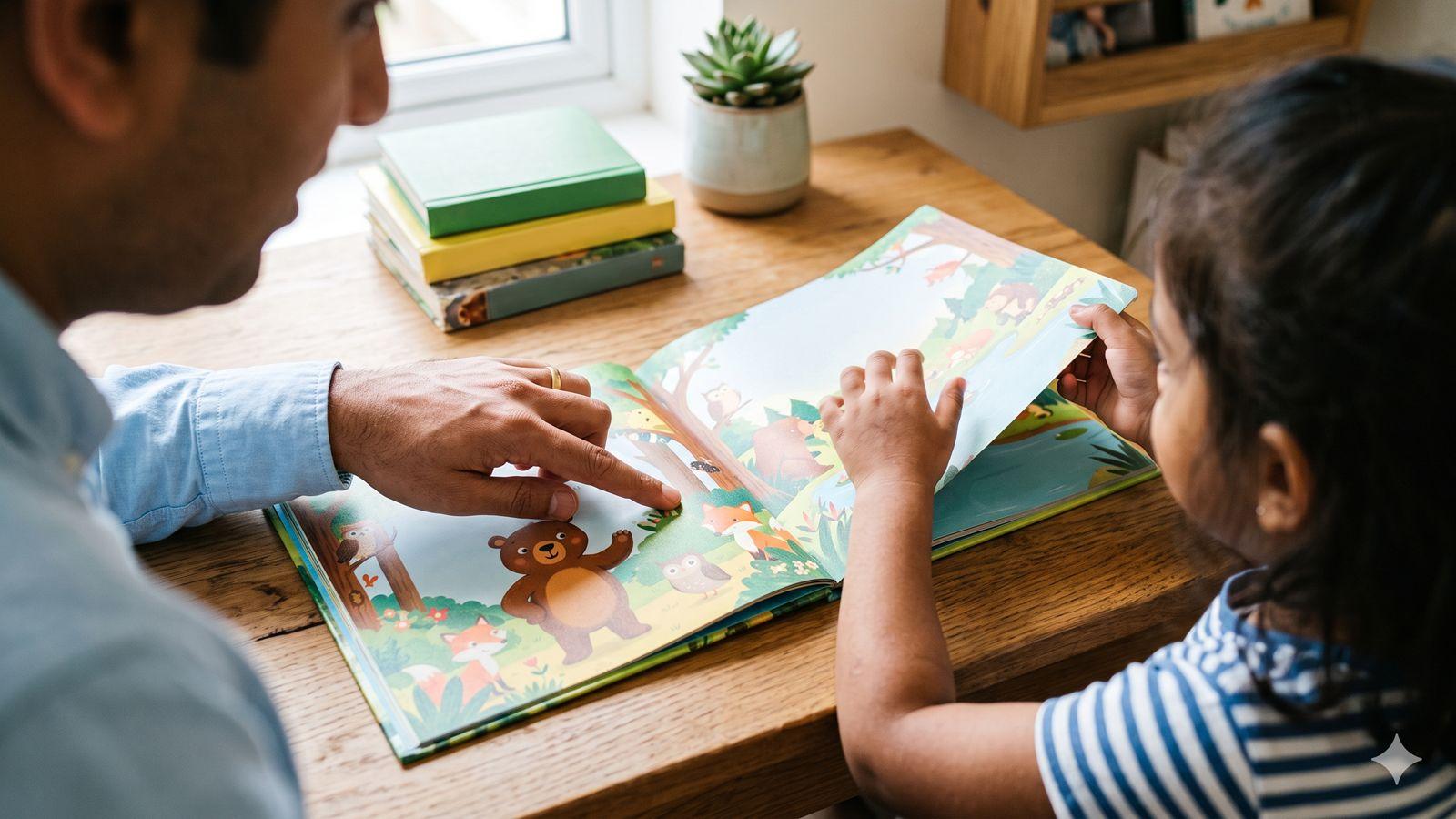
Picture books beat screens for speech, because you are in the loop, responding to your child. But you don't have to read every word on the page.
Point and name: "Look, a cow! Cow says moo."
Ask easy questions: "Where's the dog?"
Let your child turn the pages and lead.
Read the same book again and again — repetition is how words stick.
Five minutes counts. A torn, cheap book read with warmth beats a fancy one that stays on the shelf.
6. Expand on whatever they say
When your child says a word, repeat it back and add just one more. This is the therapist's "+1" technique.
Child: "Car." → You: "Red car!"
Child: "Doggy." → You: "Doggy running!"
Child: "Up." → You: "Go up!"
You're showing them the next step without pressure. One word becomes two, two becomes three — naturally, over weeks.
7. Follow their lead in play
Get down on the floor and play with whatever your child is interested in — even if it's lining up cars or pouring water again and again. Don't redirect. Join in, copy them, and add words to their activity: "Pour! More water? Pour again!"
When you enter their world instead of pulling them into yours, they engage more — and an engaged child communicates far more than a child being drilled.
What realistic progress looks like
Speech doesn't arrive in a week. Progress with a delayed talker often looks like this:
More connection first — more eye contact, more pointing, more "showing you" things.
More sounds — babbling, animal noises, attempts at words.
First words and approximations — "ba" for ball, "appa" for apple. Celebrate these loudly.
Two-word combos — "more milk", "go car".
Each stage is a real win. Notice them and celebrate them.
When to get professional help
Do these activities and see a speech-language pathologist if your child:
has no single words by 16 months, or no two-word phrases by 24 months,
has lost words or skills they previously had,
isn't responding to their name or pointing to show you things, or
isn't making progress after a few months of daily practice at home.
Home practice and professional therapy aren't either/or — together they're far more powerful than either alone.
You are your child's best therapist
You already have the two things that matter most: love, and a hundred everyday moments. Pick just two activities from this list and try them tomorrow. Keep it light, keep it playful, and follow your child's lead.
Small, joyful, daily — that's how words grow.
If you'd like personalised guidance or help finding a speech therapist near you, SpotKare is here to help you take the next step.